Some watches photograph beautifully and become less interesting the moment they reach your wrist. The Formex Aria does precisely the opposite.
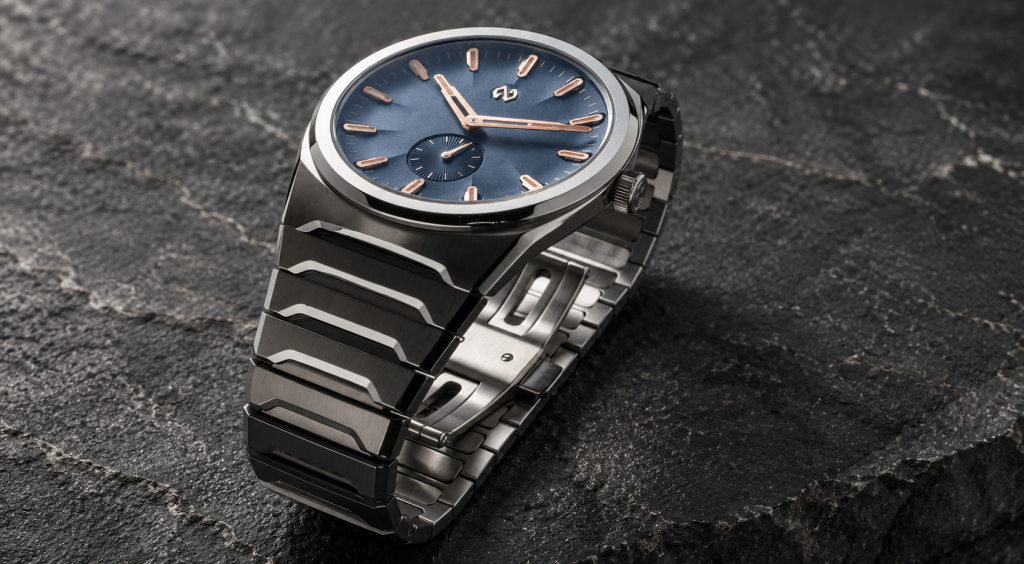
Its launch images invited immediate opinions. The flowing titanium case, scalloped bracelet, recessed dial sections, rose-gold-colored details, and ambitious price placed the Aria directly in the path of watch enthusiasts who enjoy reaching a verdict before the clasp has even been opened.
Too decorative. Too expensive. Too unusual. Too much money for a Formex.
Then you put it on.
Suddenly, the debate becomes considerably less tidy.
The Aria is not a watch that reveals itself through a perfectly lit front-facing photograph. Its appeal lives in movement: the way the case changes shape as the wrist turns, the shadows traveling across the dial, and the bracelet links folding around the arm. It is less an object to inspect than something that needs to be worn.
And once it is on the wrist, many of those early objections begin to lose their confidence.
Formex Has Stepped Into a Different Room
Formex built much of its reputation on practical engineering. The brand’s watches have generally been technical, robust, intelligently constructed, and competitively priced. Clever clasps, lightweight materials, shock-absorbing systems, and careful ergonomics were not decorative talking points; they were central to the product.
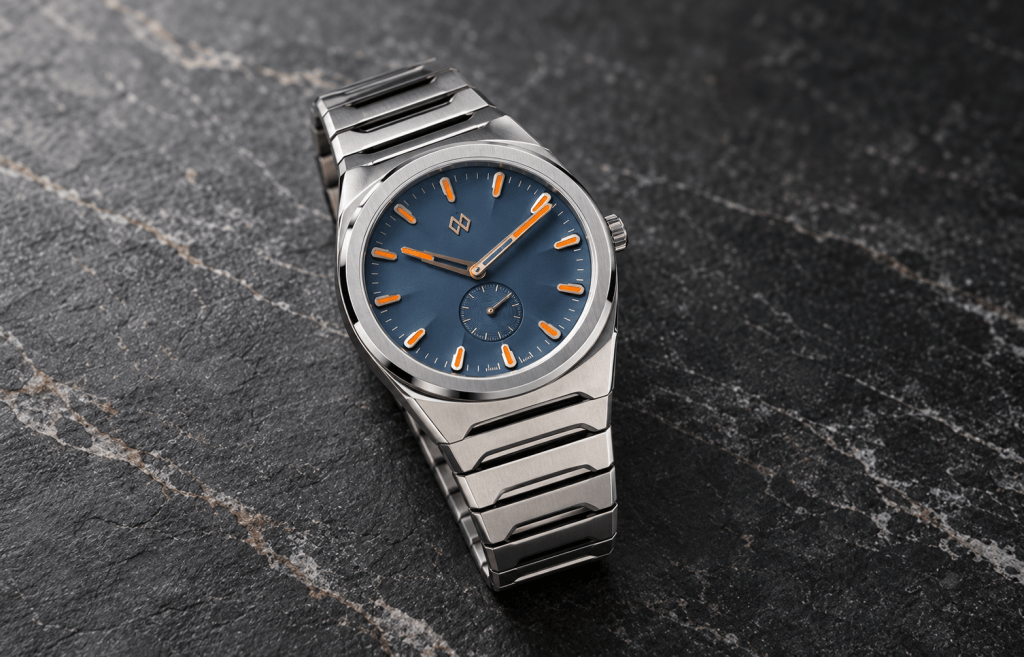
The Aria Manufacture Chronometer retains that engineering instinct but expresses it in an unfamiliar language.
This is Formex pursuing elegance.
Not traditional dress-watch elegance, with a polished round case and a conservative leather strap, but a softer, more contemporary version of luxury. The Aria is slim, sculptural, and almost liquid in profile. It represents a noticeable departure from the muscular architecture associated with watches such as the Essence and Reef.
That departure explains some of the initial resistance. The Aria does not immediately look like the Formex people already know, yet it still carries the Formex name on the dial. It asks buyers to reconsider where the brand belongs—and to do so at a significantly higher price.
That is a difficult conversation for any independent watchmaker to begin.
Titanium That Behaves Like Fabric
The numbers provide the first clue that the Aria is more unusual than it appears.
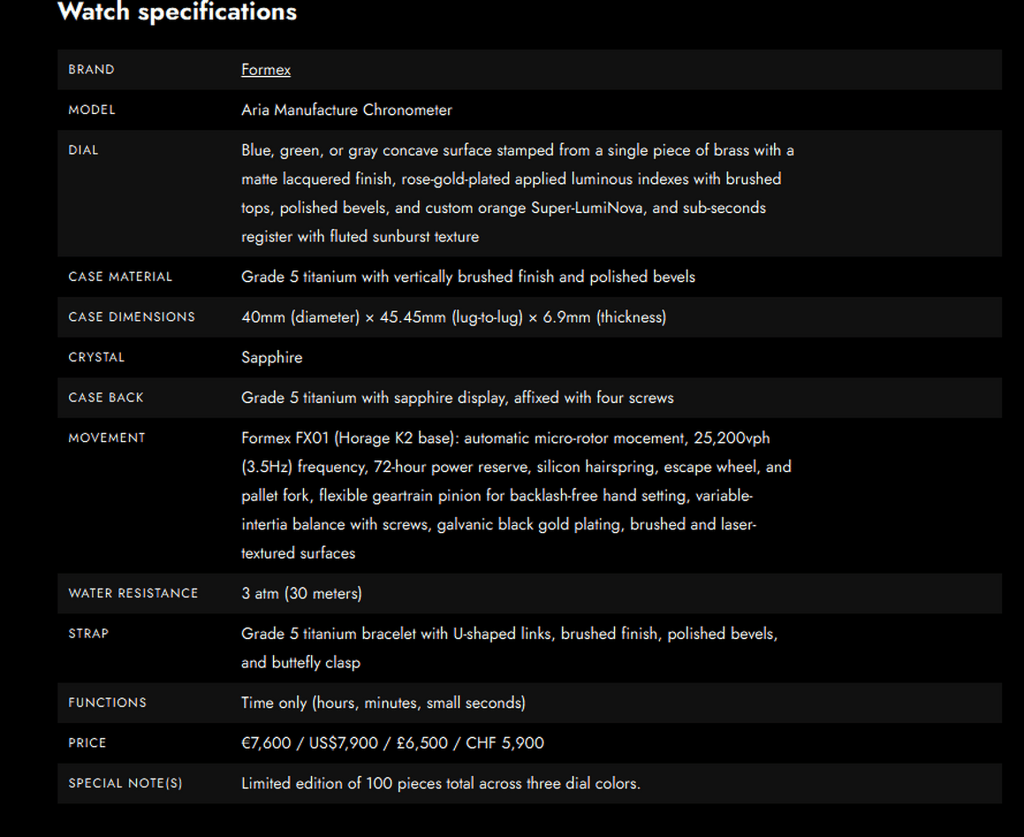
Its Grade 5 titanium case measures 40mm across, 45.45mm from lug to lug, and only 6.9mm thick. The complete watch, including its titanium bracelet, weighs approximately 78 grams.
Those dimensions sound attractive on paper, but they do not fully describe the sensation. The Aria feels extraordinarily light and low on the wrist. It does not simply fit beneath a cuff; it seems to pass under one without disturbing it.
Its thinness also changes how the 40mm diameter is perceived. A broad, thick watch announces its size vertically as well as horizontally. The Aria spreads gently across the wrist and then nearly disappears in profile. The slight curvature of the case and individual bracelet links prevents it from feeling like a flat metallic disc.
The bracelet deserves particular attention because it is responsible for much of the watch’s character. Instead of using a familiar three-link pattern or copying the angular geometry of established integrated-bracelet icons, Formex created a series of curved, overlapping forms. They resemble smooth stones arranged by moving water—or perhaps metallic scales, depending on the angle.
Every link contributes to the watch’s fluidity. The bracelet does not look attached to the case as much as it appears to continue from it.
Brushed surfaces dominate, preserving the restrained look of titanium, while polished bevels catch brief flashes of light. This contrast keeps the watch from appearing dull without turning it into wrist jewelry that demands attention from across the room.
It is a surprisingly delicate balance.
A Dial With Its Own Weather System
The Aria’s dial may be its most divisive feature, and perhaps its most successful.
Formex produces it from a single piece of stamped brass, shaping the surface into 12 concave sections surrounding the applied hour markers. These shallow depressions are easy to underestimate in static images. On the wrist, they create an almost constantly changing landscape.
Light gathers inside one section and escapes from another. Soft shadows appear around the markers before dissolving as the wrist moves. The dial can seem calm and nearly flat in one moment, then deeply sculpted in the next.
It has its own weather system.
The applied markers and skeletonized hands are rose-gold plated, adding warmth to the otherwise cool titanium construction. Custom Super-LumiNova provides nighttime visibility, although this is clearly not a watch designed around maximum lume performance. The recessed small-seconds display at six o’clock gives the lower half of the dial additional depth while preserving the Aria’s clean symmetry.
Three colors were created for the Founders Edition: Denso Blue, Selva Green, and Ardesia Grey.
Ardesia Grey is the most architectural of the three. It allows the dial’s shapes, shadows, and metallic accents to carry the design. Denso Blue feels more familiar but changes noticeably under different lighting. Selva Green is the most expressive option, giving the sculpted surface a richer and slightly more organic personality.
None of them is loud in the conventional sense. The drama comes from form rather than saturation.
There are cleaner dials. There are more immediately beautiful dials. But very few behave quite like this one.
The Movement Explains the Body
An ultra-thin case can quickly become an exercise in compromise. Formex avoided that trap by developing the exclusive FX01 automatic caliber with Swiss movement specialist Horage.
Based on Horage’s K2 architecture, the FX01 measures only 2.9mm thick. Its compact tungsten micro-rotor sits within the movement rather than above it, eliminating the need for a conventional full-size rotor and helping the entire watch remain remarkably slender.
This is not thinness achieved merely for a headline.
The movement operates at 25,200 vibrations per hour and supplies more than 72 hours of power reserve. A complete silicon regulating system—including the hairspring, escape wheel, and pallet fork—improves resistance to magnetism while reducing mass and friction. Each movement is also tested and certified by COSC, with a stated accuracy standard of −4/+6 seconds per day.
Formex has even addressed the small amount of play sometimes felt when setting a watch. A flexible, backlash-free gear-train pinion is intended to make hand-setting more direct and precise.
Turn the Aria over and the movement does not resemble a generic caliber dressed for the occasion. Its black-gold treatment, vertically brushed bridges, textured recesses, beveled edges, and engraved micro-rotor give it a darker, more technical personality than the dial.
The contrast works. The front is fluid and expressive; the back reveals the machinery making that thinness possible.
Calling the FX01 entirely “in-house” would oversimplify its origins, but dismissing it as an ordinary supplied movement would be equally misleading. It is an exclusive Formex execution of an advanced Horage platform, developed and finished specifically for this watch.
The Clasp Solves an Integrated-Bracelet Problem
Beautiful integrated bracelets sometimes become considerably less romantic when the temperature rises.
A bracelet adjusted perfectly in the morning can feel tight later in the day as the wrist expands. Formex addresses that problem with its patented micro-adjustment system, providing 3mm of adjustment on either side of the clasp.
The adjustment can be made without removing the watch.
It sounds like a minor convenience until you have lived with an integrated bracelet that offers none. On a watch whose identity depends so heavily on comfort and uninterrupted visual flow, proper adjustment is not a bonus. It is essential.
The bracelet also uses a quick-release system and screwed links, making sizing and removal less frustrating than the exterior design might suggest.
This is where the old Formex remains visible beneath the Aria’s new clothing. The watch may be elegant, but someone was still thinking about swollen wrists, screwdriver access, and the annoying realities of daily wear.
The 30-Meter Question
There is, however, one number that feels less convincing: 30 meters of water resistance.
It is understandable within the context of a 6.9mm automatic watch with sapphire crystals on both sides. The Aria is not pretending to be a dive watch, nor is it designed for careless underwater use.
Still, this is a titanium sports watch with an integrated bracelet. A rating of 50 meters—or preferably 100—would have made its everyday proposition feel more complete.
Thirty meters does not make the Aria fragile, but it changes the relationship. This is a watch to wear through ordinary life, not one to leave on without thinking before swimming. For a design that otherwise feels so effortless, that small moment of hesitation is unfortunate.
The Price Is Where the Argument Begins
The Formex Aria Manufacture Chronometer was introduced as a 100-piece Founders Edition priced at CHF 5,900, €7,600, or $7,900.
That is a substantial amount of money. More importantly, it places Formex in a category where buyers are no longer comparing specifications alone. Brand recognition, resale value, history, emotional attachment, and social perception become increasingly influential.
At this level, the Aria competes not only against other technically impressive independents but also against established luxury names available new or pre-owned. Some buyers will see the Formex logo and stop there.
Others will look at the construction: a Grade 5 titanium case and bracelet, elaborate mixed finishing, a thickness below 7mm, an exclusive Swiss micro-rotor caliber, full silicon regulation, COSC certification, a 72-hour reserve, and a genuinely useful micro-adjustment system.
Viewed from that angle, the price no longer appears absurd. It simply appears ambitious.
There is an important difference.
Formex is not charging nearly $8,000 for a familiar watch with a different dial color. The brand has created its most sophisticated case, bracelet, dial, and movement package to date. Whether the name carries enough emotional weight to justify the purchase is personal, but the physical watch makes a serious case for itself.
Some Watches Need Time Before They Need Approval
The Aria is unlikely to win everyone over, and that may be one of its strengths.
Its dial will be too decorative for minimalists. The rose-gold accents will divide opinion. The water resistance could be better, and the price asks buyers to place considerable faith in a comparatively young name. Anyone choosing a watch primarily for resale security will probably look elsewhere.
But the Aria was not created to be the safe answer.
It is a watch for someone who has already seen enough integrated bracelets, enough blue textured dials, and enough steel sports watches cautiously arranged around familiar design codes. Its personality does not come from one dramatic feature. It emerges through the interaction of weight, thinness, shape, light, and movement.
That is why photographs struggle to explain it.
The Formex Aria begins as an argument on a screen: the styling, the name, the specifications, the price. On the wrist, those separate points stop competing and become one remarkably coherent object.
You may still decide it is not for you.
Just make that decision after trying it on.
The Aria has already heard enough opinions from people who have never met it.


Leave a Reply