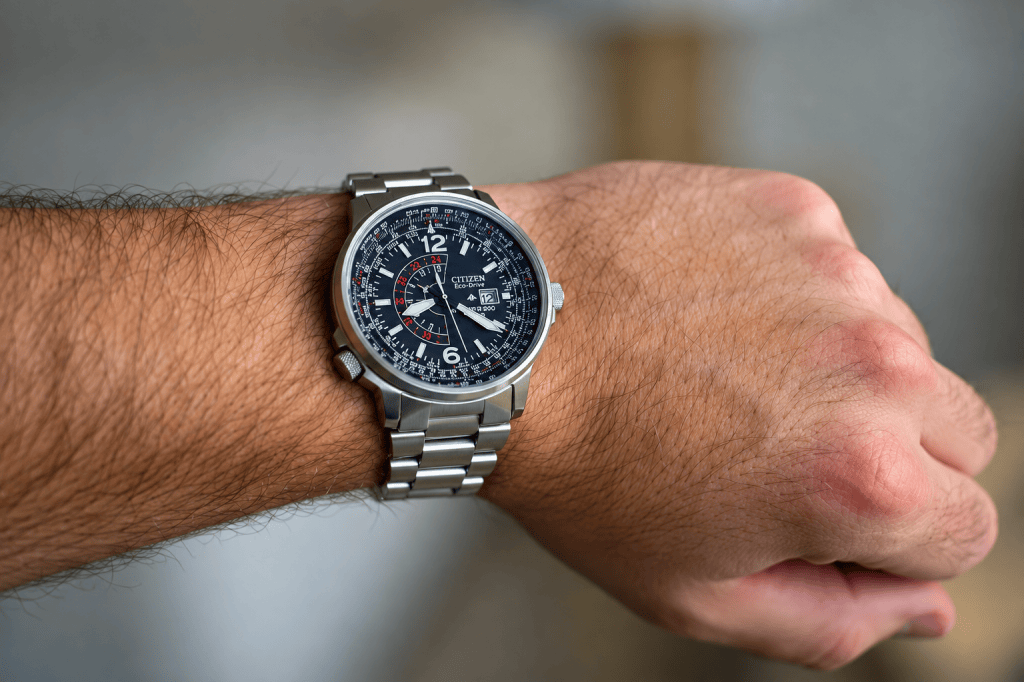
The Citizen Nighthawk is one of those watches that manages to stand out without trying too hard. It has a busy aviation-inspired dial, plenty of functionality, solid construction, and Citizen’s incredibly practical Eco-Drive movement.
For us, what makes the Nighthawk particularly interesting is how much watch you’re getting for the money. It looks different from most pilot watches, feels genuinely useful, and has enough durability to work as an everyday watch.
CHECK THE NIGHTHAWK ON AMAZON>>
That doesn’t mean it’s perfect. The large-looking dial, limited compatibility with thicker straps, and mineral crystal are all worth considering before buying one.
Here are five reasons we think the Citizen Nighthawk deserves a place on your shortlist — followed by three things we’d keep in mind before purchasing it.
Citizen Nighthawk: The Basics
Before getting into what makes it special, here are the main specifications:
- 42mm case diameter
- 47mm lug-to-lug
- 12mm thickness
- Mineral crystal
- Stainless steel bracelet
- 200 meters of water resistance
- Screw-down crown
- Citizen Eco-Drive movement
- GMT functionality
- Pilot-style slide-rule bezel
On paper, those specifications already make the Nighthawk look like a capable everyday watch. On the wrist, however, there’s much more personality than the numbers suggest.
1. It Has a Distinctive Pilot-Watch Design
The first thing we like about the Citizen Nighthawk is its design.
Many pilot watches lean heavily into traditional military styling. They often look like watches inspired directly by aviation pieces from the 1940s, ’50s, or ’60s.
The Nighthawk goes in a different direction.
It still clearly belongs in the aviation world, but it feels much more modern. The dial is complicated and technical, yet the watch doesn’t cross into overly futuristic territory.
Instead, there’s an almost industrial quality to it.
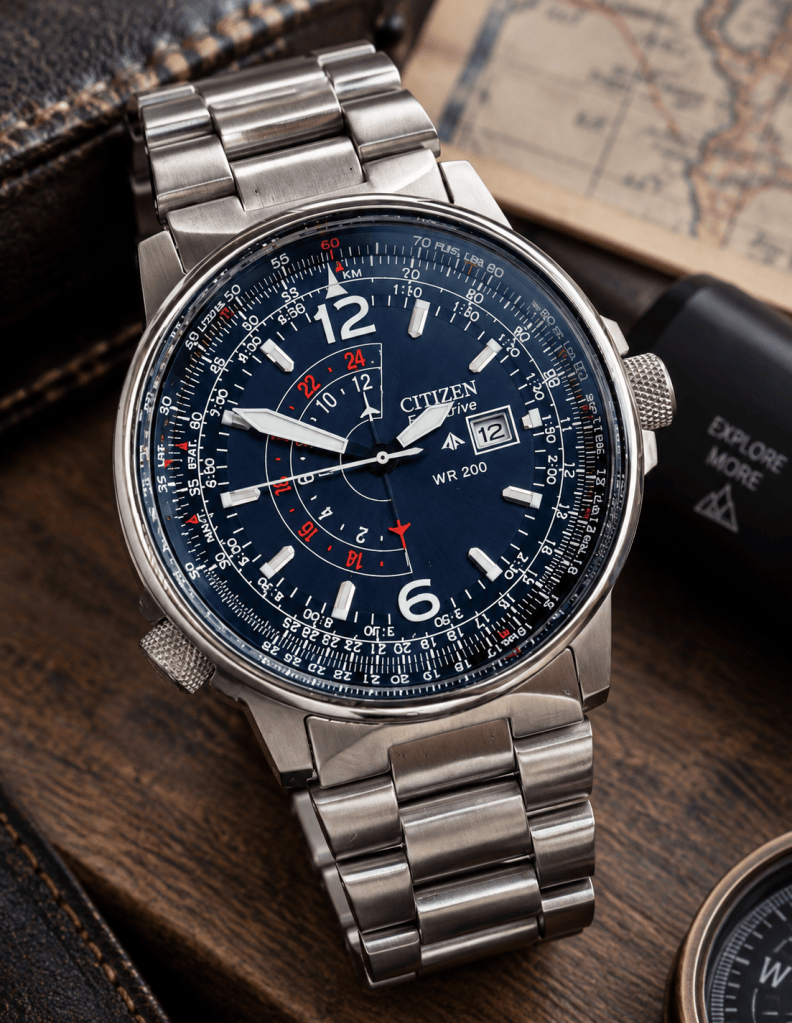
The angular case, crown, lugs, dial layout, and bracelet make the Nighthawk feel more like a small piece of machinery than a conventional wristwatch.
Even the bracelet contributes to that appearance. Viewed from the side, the links have a shape that can remind us of an aircraft wing, which fits surprisingly well with the overall aviation theme.
Despite its bold appearance, the relatively short 47mm lug-to-lug measurement helps keep it manageable on the wrist.
That combination is one of the Nighthawk’s biggest strengths: it looks substantial without necessarily wearing as huge as you might expect.
2. It Actually Feels Like a Tool Watch
The term “tool watch” gets used a lot, but the Nighthawk genuinely earns it.
Rather than simply borrowing the visual style of aviation instruments, Citizen gave this watch functions connected to flying and travel.
The most obvious example is the slide-rule bezel.
At first glance, it might seem unnecessarily complicated. Most of us probably aren’t going to use a mechanical slide rule every day when a phone can perform the same calculation instantly.
But that’s almost beside the point.
The slide rule can actually be used for calculations such as multiplication, division and unit conversions. It can even help with calculations related to fuel consumption.
For everyday use, converting between units such as kilometers and miles or kilograms and pounds is probably one of the more realistic uses.
Do we need this on our wrist?
Probably not.
But that’s part of the charm.
It’s similar to owning a capable dive watch even if we’re never going deep-sea diving. The functionality gives the watch character and connects it to the world it was designed to represent.
The GMT Display Is One of the Best Parts
The Nighthawk also includes a GMT function, allowing us to keep track of another time zone.
Citizen handles the display in an unusual way.
Instead of simply placing a conventional 24-hour scale around the dial, the Nighthawk uses a distinctive semicircular layout with contrasting markings.
The double-sided GMT hand makes the display even more interesting. The different sides of the hand correspond with the appropriate sections of the scale, making it possible to distinguish between daytime and nighttime hours in the second time zone.
Once we’re familiar with the layout, it’s surprisingly intuitive.
There’s another practical feature here too: the main hour hand can be adjusted in one-hour increments while remaining synchronized with the minutes and GMT display.
That can be particularly useful while traveling because we can adjust the local hour without having to completely reset the watch.
It might look complicated at first, but there’s real thought behind the dial.
The Lume Simplifies Everything at Night
One of our favorite details is how dramatically the Nighthawk changes in darkness.
During the day, the dial is packed with numbers, scales, hands and information.
At night, most of that visual complexity disappears.
What remains is a much simpler display focused primarily on the information we actually need to tell the time.
The lume isn’t necessarily the strongest reason to buy the Nighthawk on its own, but the contrast between its daytime and nighttime appearance gives the watch another layer of personality.
It almost feels like two different watches depending on the lighting.
3. It’s Built to Handle Everyday Use
Despite being designed around an aviation theme, the Nighthawk is surprisingly capable around water too.
Citizen gives it 200 meters of water resistance along with a screw-down crown.
That makes it far more versatile than we might expect from a pilot-style watch.
It’s the kind of watch we can wear while traveling, walking around a city, spending time outdoors or swimming without constantly worrying about it.
The stainless steel construction also feels appropriately substantial for a watch with this personality.
The Bracelet Deserves Some Credit
Affordable watches often come with bracelets that feel like an afterthought.
That’s not really the case here.
The Nighthawk’s bracelet complements the design of the case and dial rather than looking like something Citizen simply attached at the end of the design process.
The finishing works with the watch, the links feel solid, and the bracelet reinforces that mechanical, aviation-inspired appearance.
It’s one of those watches that simply looks right on its factory bracelet.
Thankfully, Citizen didn’t make it a fully integrated design, so we still have the option of changing straps if we want a different appearance.
There is a catch to that, which we’ll get to later.
4. Eco-Drive Makes It Incredibly Practical
If there is one Citizen technology that makes a strong argument for practicality, it’s Eco-Drive.
The Nighthawk uses light to keep its internal power cell charged. That means we don’t have to think about regularly replacing a conventional quartz battery.
Give the watch enough exposure to light and it simply keeps going.
The movement also has a long power reserve, so it doesn’t need to sit in direct sunlight constantly. Once charged, it can continue operating for months without additional light exposure.
That’s one of the reasons we think the Nighthawk works so well as a grab-and-go watch.
Mechanical watches have their own charm, but sometimes we simply want to pick up a watch and know the time will already be correct.
Eco-Drive delivers exactly that experience.
Combine that convenience with GMT functionality, strong water resistance and a tough stainless steel case, and the Nighthawk becomes a particularly appealing travel watch.
5. You Get a Lot of Watch for the Money
Value is probably the biggest reason the Nighthawk has remained so appealing.
We’re getting a watch from an established manufacturer with Eco-Drive, GMT functionality, a slide-rule bezel, 200 meters of water resistance, a screw-down crown and solid stainless steel construction.
That’s a lot packed into one watch.
It also doesn’t feel generic.
There are countless affordable watches with good specifications, but fewer have an identity as recognizable as the Nighthawk.
That’s important.
Specifications can tell us whether a watch is technically good value, but they don’t necessarily make us want to wear it. The Nighthawk combines useful specifications with a design that has genuine personality.
There are also several versions of the Nighthawk available, including variations with different dial and strap combinations.
The Blue Angels version is one of the more recognizable alternatives for anyone who wants an even stronger aviation connection.
But There Are 3 Things We Don’t Love
No watch gets everything right, and the Nighthawk has a few compromises worth knowing about.
None of these automatically make it a bad purchase, but they could matter depending on what we want from a watch.
1. It Looks Bigger Than 42mm
The Nighthawk measures 42mm across, which isn’t particularly unusual for a modern sports watch.
However, measurements don’t tell the entire story.
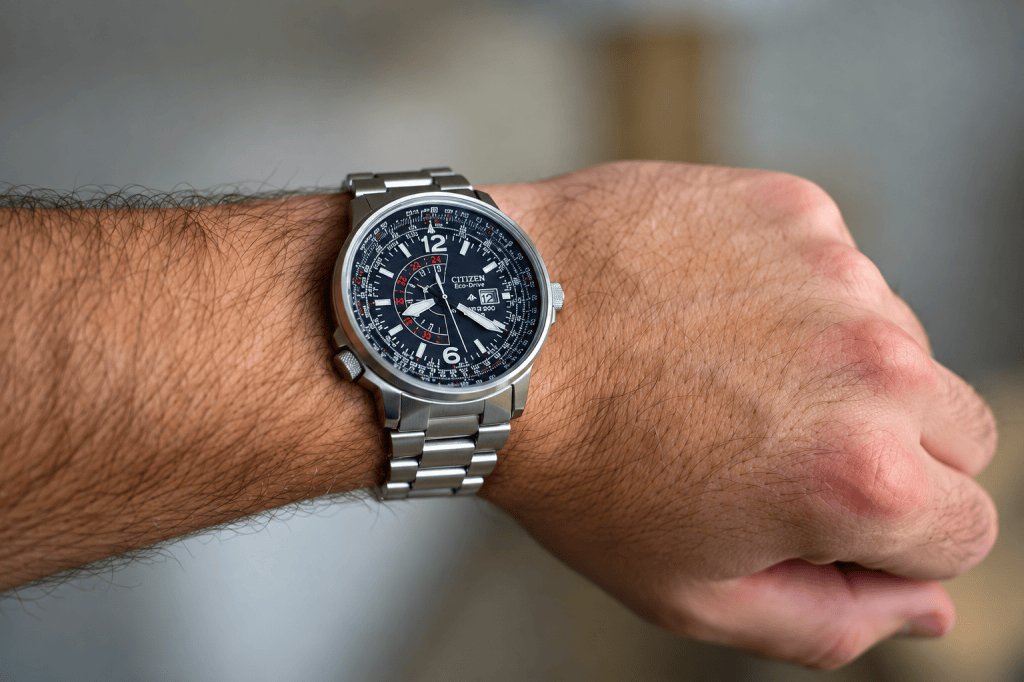
Because so much of the front of the watch is occupied by the dial and crystal, the Nighthawk can visually appear larger than its 42mm diameter suggests.
That’s an important distinction.
It doesn’t necessarily wear extremely large.
The relatively short 47mm lug-to-lug measurement helps the case sit comfortably on the wrist. But when we look down at it, the expansive dial makes the watch appear substantial.
So someone comfortable with other 42mm watches could still feel that the Nighthawk looks bigger.
If we prefer watches with a lot of wrist presence, that’s probably a positive.
If we prefer smaller and more understated watches, it’s something to consider.
2. Not Every Strap Will Fit
The second issue is the space around the lugs.
The Nighthawk’s lugs sit relatively close to the case, leaving limited clearance for thicker straps.
Standard leather straps, thinner NATO straps and slimmer rubber options should give us more flexibility.
Thick leather straps are another story.
The same applies to particularly heavy NATO straps. Thick seatbelt-style NATO straps and leather NATO straps can be difficult to fit because there simply isn’t much room between the spring bars and case.
That doesn’t mean we’re stuck with the bracelet forever.
There are still plenty of strap combinations that can work.
But if we’re someone who enjoys constantly switching between thick straps, the Nighthawk isn’t the most strap-friendly watch available.
Fortunately, the original bracelet is good enough that keeping it on steel doesn’t feel like much of a compromise.
3. The Mineral Crystal Will Pick Up Scratches
This is probably the most obvious compromise.
The Nighthawk uses a mineral crystal rather than sapphire.
Mineral crystal can pick up scratches over time, particularly if we’re wearing the watch frequently.
For some buyers, that’s going to be frustrating.
If we expect the crystal to remain almost flawless for years, we’d probably prefer sapphire.
On the other hand, the Nighthawk isn’t trying to be a delicate dress watch.
It’s a rugged, industrial-looking tool watch. A few small marks don’t necessarily look completely out of place on something designed with this kind of character.
We could almost think of them as evidence that the watch is actually being worn.
Still, it’s something we’d want to know before buying.
There are aftermarket sapphire replacement options discussed by Nighthawk owners, but for most buyers, we’d simply treat the mineral crystal as one of the compromises Citizen made to keep the watch affordable.
Is the Citizen Nighthawk Worth Buying?
For us, the appeal of the Citizen Nighthawk comes down to how well everything works together.
It’s not just an inexpensive watch with a long specification sheet.
It has an identity.
The aviation-inspired dial gives it character. The GMT complication adds genuine everyday usefulness. The slide-rule bezel is unusual and fun to explore. Eco-Drive makes ownership incredibly easy, while the 200-meter water resistance means we don’t have to treat it delicately.
Most importantly, the Nighthawk doesn’t look like everything else.
There are cleaner pilot watches. There are smaller watches. There are watches with sapphire crystals and more flexible strap options.
But few combine the Nighthawk’s unusual design, functionality, durability and practicality in quite the same way.
The large-looking dial and mineral crystal won’t be for everyone, and we’d definitely think about wrist size and strap preferences before buying.
If those compromises don’t bother us, though, the Citizen Nighthawk remains a very compelling everyday pilot watch — and one with enough personality to keep things interesting long after the novelty wears off.
Disclosure: This article may contain affiliate links. If you purchase through one of our links, we may earn a commission at no extra cost to you.


Leave a Reply