We’ve rounded up some budget-friendly watches that look far more expensive than their price tags suggest.
Christopher Ward C63 Valour
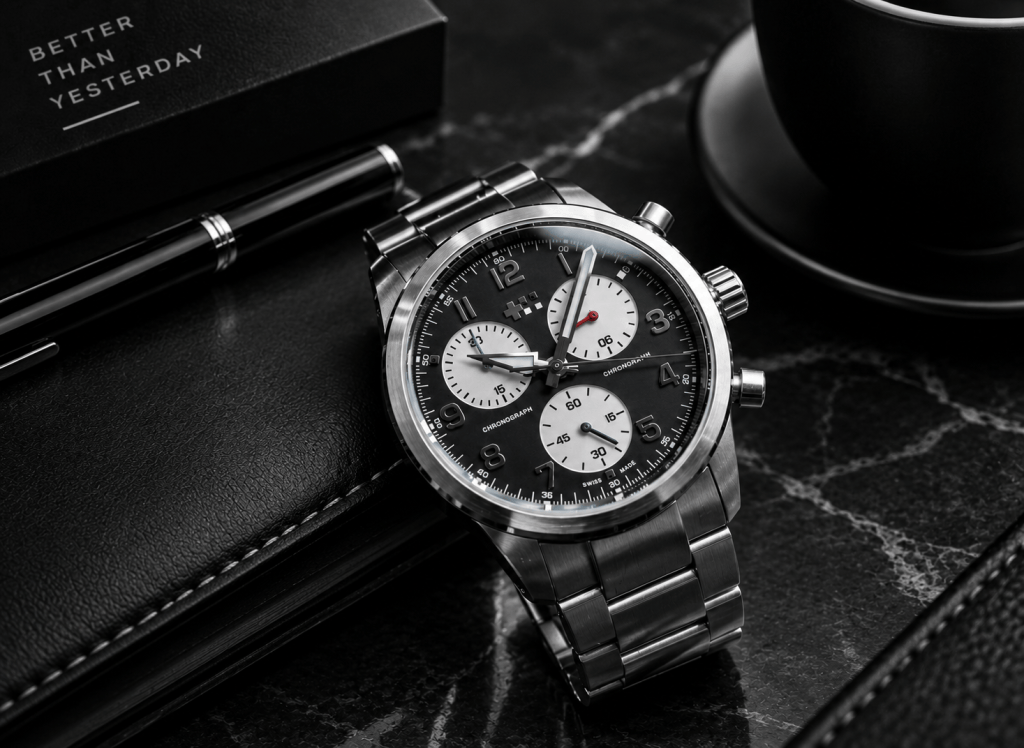
Buying a chronograph as your one-and-only watch can come with some obvious drawbacks. Many models are relatively thick, somewhat cumbersome for daily wear, and built around mechanical movements that are enjoyable but not always the most convenient. The Christopher Ward C63 Valour takes a different approach. Rather than feeling like a dedicated chronograph that happens to work as a daily watch, it feels like a versatile everyday timepiece with stopwatch functionality built in. That distinction is what makes it particularly appealing for a one-watch collection.
Its dimensions are one of the first things that stand out. Measuring 39 mm in diameter and around 46 mm from lug to lug, the C63 Valour has a compact presence without feeling undersized. It also avoids the bulky, top-heavy sensation found on plenty of chronographs. The Bader bracelet adds to the everyday comfort. With a 20 mm starting width that tapers down to approximately 16 mm, quick-release spring bars, and a convenient micro-adjustment system, it quickly becomes something you simply stop noticing on the wrist — which is exactly what you want from a daily bracelet.
The case design is another strong point. Christopher Ward calls it the “Light-catcher” case, a name that might sound slightly dramatic, but the combination of brushed and polished surfaces genuinely gives it plenty of character. Its appearance changes noticeably depending on how the light hits it. The reverse panda dial continues that theme of understated contrast. Applied Arabic numerals provide some additional depth, while the contrasting sub-dials make the chronograph information easy to read. Military-inspired touches add a little color without overwhelming the otherwise clean layout.
The chronograph controls are equally satisfying. The pushers have a firm, precise feel, making the stopwatch function something you actually enjoy using rather than a feature that’s simply there for the sake of appearance.
Inside, the ETA quartz movement is arguably one of the watch’s biggest advantages for everyday ownership. With COSC certification and an accuracy rating of approximately ±10 seconds per year, it offers an exceptional level of precision without demanding the attention that a mechanical movement often does. For someone looking for a watch that can simply be worn and trusted every day, that kind of reliability is hard to overlook.
There are a couple of minor drawbacks. The bracelet can develop a small squeak during the early stages of ownership, although this may settle with use. And while the quartz movement is incredibly practical, traditionalists who love the winding, servicing, and mechanical character of a chronograph may find it less appealing. Likewise, those looking for a more dramatic or colorful military-inspired design might find the Valour’s details a little too restrained.
Still, for someone who wants the appearance and functionality of a chronograph without making mechanical ownership part of their daily routine, the C63 Valour is a particularly convincing option. It combines sensible dimensions, excellent accuracy, strong finishing, and genuine everyday usability in a package that works remarkably well as a single-watch collection.
Pros
- COSC-certified ETA quartz movement provides exceptional accuracy and requires very little maintenance.
- 39 mm case size and compact lug-to-lug dimensions make it comfortable for everyday wear.
- Bader bracelet offers excellent comfort and useful tool-free adjustment.
- Reverse panda dial provides strong contrast and easy readability.
- Chronograph pushers have a precise and satisfying action.
Cons
- The bracelet may produce a minor squeaking sound during early ownership.
- The military-inspired styling is fairly subtle and may feel understated to some buyers.
- Dedicated mechanical-watch enthusiasts may not appreciate the quartz movement.
Finding a single watch for around $1,000 is surprisingly difficult simply because there are so many strong options available. Ultimately, the best choice isn’t necessarily the one with the most impressive specifications or the one that looks best in a collection. It’s the watch that fits naturally into your actual lifestyle and that you can imagine wearing repeatedly for years.
So, if you had to choose one watch under $1,000 and wear it every day for the next five years, which one would you pick — and what makes it the one?
Nodus Contrail GMT
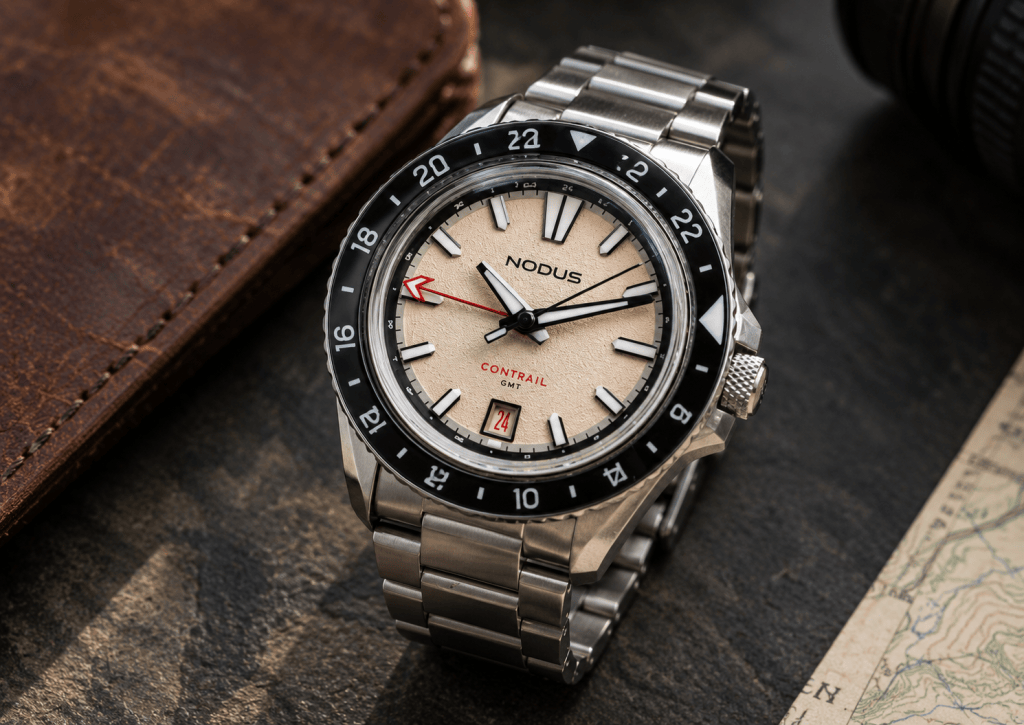
The Nodus Contrail GMT Laguna takes a slightly different approach to the modern travel watch. Rather than trying to imitate the usual Seiko-style formula or leaning heavily on vintage-inspired design, it feels purpose-built for people who actually want the convenience of a GMT. That makes it particularly compelling as a one-watch option. Its appeal comes less from nostalgia and more from how naturally the watch fits into everyday travel and daily wear.
The Miyota 9075 movement is the biggest reason for that practicality. Its flyer GMT functionality allows the local hour hand to be adjusted independently, meaning you can arrive in another time zone and make the necessary change in just a few seconds. Once you’ve become accustomed to that system, a traditional caller GMT can feel unnecessarily cumbersome. The large screw-down crown also works well here, providing enough grip to make setting the watch straightforward and controlled.
Despite housing the relatively substantial Miyota movement, the case remains impressively wearable. It measures 40.5 mm in diameter, 46.6 mm from lug to lug, and just 11.8 mm thick. The curved or twisted lugs help it sit naturally against the wrist, while the combination of brushed and polished surfaces gives the case some visual depth. A box-shaped sapphire crystal, sapphire bezel insert, and 200-meter water resistance further reinforce the idea that this is a watch meant to be used rather than carefully protected.
The Laguna configuration is also where the Contrail GMT starts to separate itself from the competition. Its sandy-colored dial has a subtle texture that changes with the lighting, offering something different from the sea of black and blue GMT dials. The roulette-style date wheel adds another small visual detail without cluttering the display.
Using the GMT functions is equally straightforward. The 48-click bidirectional bezel, internal 24-hour scale, and clearly differentiated hands make keeping track of another time zone relatively intuitive. The BGW9 lume is another welcome feature. It covers the hour markers, bezel numerals, and GMT hand, providing genuinely useful visibility in low-light conditions instead of simply being included as a specification.
Nodus also put plenty of thought into the bracelet. Screw links make sizing easier to manage, while the NodeX clasp provides convenient on-the-fly adjustment when your wrist changes throughout the day. The clasp is somewhat substantial compared with the rest of the bracelet, however, and the limited taper doesn’t quite match the otherwise refined feel of the watch. Larger internal 24-hour numerals would also make the GMT information faster to read at a glance.
Those are relatively minor criticisms, though. The Contrail GMT Laguna succeeds because it focuses on functionality without sacrificing personality. For anyone putting together a one-watch collection and wanting genuine flyer GMT capability, strong water resistance, a relatively thin case, and a design that doesn’t simply copy the usual travel-watch formula, it’s an unusually well-rounded choice.
Pros
- Miyota 9075 flyer GMT movement makes switching between time zones quick and convenient.
- 11.8 mm thickness gives it a relatively slim profile for a GMT using this movement.
- BGW9 lume on the hands, markers, bezel, and GMT hand offers strong nighttime visibility.
- NodeX clasp provides easy tool-free adjustment during the day.
- Textured sandy dial and roulette date bring character while keeping the display clean.
Cons
- The NodeX clasp is noticeably more substantial than the rest of the bracelet.
- Bracelet taper could be more pronounced for a more refined appearance.
- The internal 24-hour markings would benefit from being larger and easier to read quickly.
Citizen Nighthawk
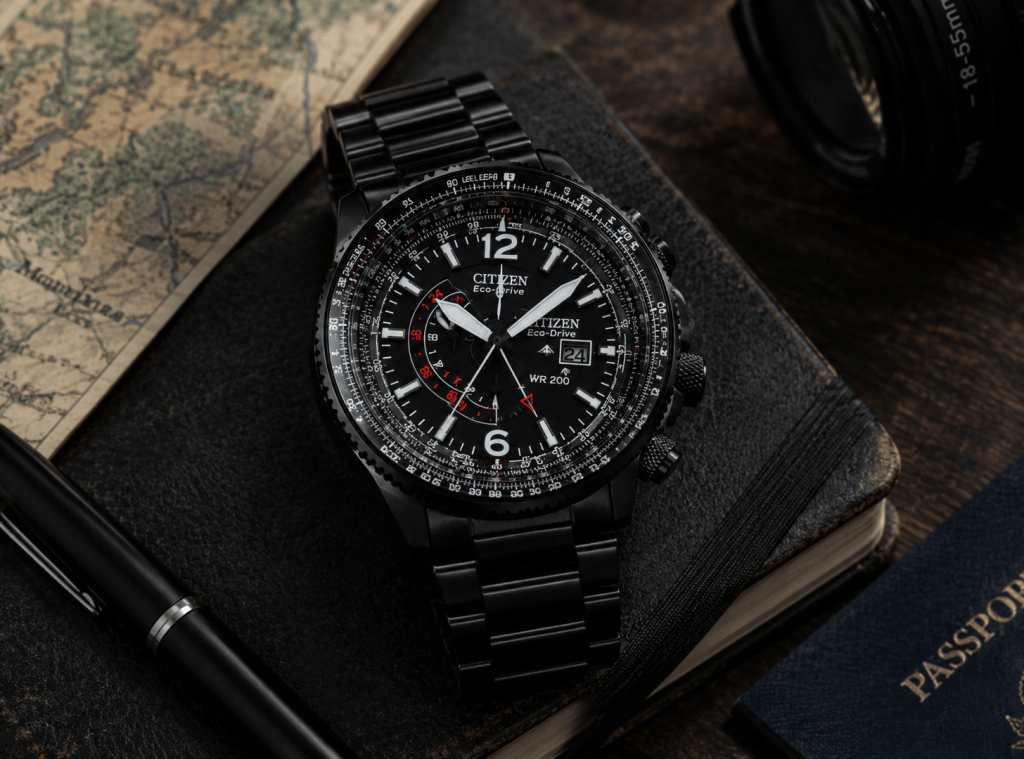
A one-watch collection can be approached in several ways. Some people prioritize versatility, while others want maximum functionality from a single timepiece. The Citizen Nighthawk is aimed firmly at the second group. It has far more visual presence than a basic field watch, and its aviation-inspired design is clearly meant to stand out. Yet its biggest strength became apparent through everyday use: it is remarkably convenient. Whether checking another time zone, heading away for the weekend, or simply choosing a watch in a hurry, the Nighthawk rarely demands much thought before putting it on.
Much of that convenience comes from Citizen’s Eco-Drive B877 movement. Because it charges using light, routine battery replacements are essentially removed from the equation. During testing, accuracy remained around ±15 seconds per month, while a full charge provided approximately six months of power. The independently adjustable local hour hand is another particularly useful feature. Changing time zones takes very little effort, making the watch practical even for people who don’t regularly travel internationally.
The dial initially looks intimidating. The integrated E6B flight-computer scale creates a lot of visual information, but it becomes considerably easier to understand after spending some time with the watch. The layout has a natural hierarchy: the large sword-shaped hands and luminous applied markers immediately stand out, while the red-and-white airplane-style GMT hand adds another clear point of reference. The more complicated scales tend to fade into the background until they’re actually needed. The blue lume is also impressively effective at night and adds another layer of practicality.
There are, however, some compromises. The 42.5 mm black ion-plated case has a substantial presence on the wrist and isn’t particularly discreet beneath a shirt cuff. The mineral crystal is another area where we would have preferred sapphire. The main hands can occasionally obscure parts of the secondary time-zone markings, while sufficiently deep scratches can expose the underlying steel beneath the black coating.
Fortunately, those drawbacks don’t undermine the overall package. The screw-down crown, screw-down caseback, locking secondary crown, and 200-meter water resistance give the Nighthawk plenty of protection for normal everyday adventures. It feels like a watch that can be worn without constantly worrying about where you are or what you’re doing.
For someone building a one-watch collection around practicality rather than formal elegance, the Nighthawk remains an especially strong option below $1,000. It offers solar power, useful GMT functionality, serious water resistance, and a distinctive aviation-inspired design without demanding much attention from its owner.
Pros
- Eco-Drive B877 provides solar charging, solid accuracy, and an independently adjustable local hour hand with minimal maintenance.
- 200-meter water resistance plus screw-down components make it suitable for worry-free daily use.
- The complicated dial becomes surprisingly easy to navigate once you become familiar with it.
- Strong blue lume provides excellent visibility in darker conditions.
- Solid bracelet and deployant clasp provide a secure fit, with safety locking and micro-adjustment.
- Approximately six months of power reserve means the watch can sit unused and still be ready when needed.
Cons
- The 42.5 mm case gives the watch considerable wrist presence and weight.
- Mineral glass is less desirable than sapphire at this price point.
- The primary hands can occasionally interfere with the secondary time-zone markings.
- Heavy scratches can expose the bare steel underneath the black ion-plated finish.
Seiko 5 GMT
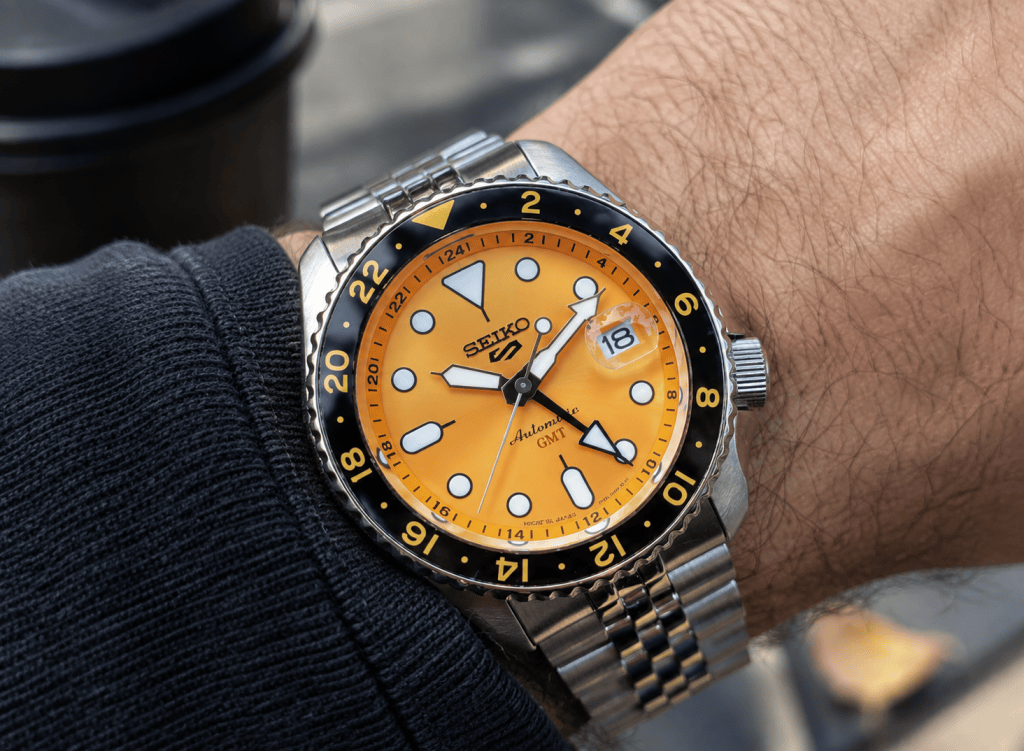
The Seiko 5 GMT makes a strong case for itself as a one-watch option for anyone who wants a little more functionality than basic timekeeping. You don’t have to be a frequent traveler to appreciate having a second time zone readily available. During everyday use, the GMT complication never felt intrusive or overly complicated; it simply stayed there until it was actually useful. The 4R34 is a caller GMT, meaning the local hour hand cannot be adjusted independently, so serious international travelers may prefer a flyer GMT. For keeping track of relatives abroad, coordinating with colleagues in another country, or preparing for an upcoming trip, however, it works perfectly well. The rotating 24-hour bezel also adds the ability to follow a third time zone, which turned out to be a surprisingly practical feature.
The dial is arguably what makes the watch convincing as a one-watch collection. The orange sunburst finish has considerably more character in person than photographs tend to show, changing noticeably as it catches different angles of light. Rather than making the dial feel overly busy, the black GMT hand, dark surrounds around the applied markers, gold-toned hands, and generous Lumibrite work together to create a surprisingly balanced display. Even with all the additional information, reading the time remains quick and straightforward. The magnifying lens over the date may divide collectors, but after a few days it became easy to stop noticing.
Seiko’s familiar sports-watch case is another reason the watch works so well. At 42.5 mm, it sounds fairly large on paper, but its rounded shape and relatively short, softened lugs keep the overall wrist presence under control. With a lug-to-lug measurement of approximately 46 mm, it feels considerably more compact than the diameter would suggest. There’s enough weight and solidity to make it feel substantial, without becoming uncomfortable during extended wear.
As expected from a Seiko in this price bracket, there are a few compromises. The push-pull crown and 100-meter water resistance aren’t particularly impressive compared with the specifications of the legendary SKX models. That said, the watch never felt delicate in normal use, and independent pressure testing has suggested that its real-world resistance can be better than the official rating might lead you to believe.
The Jubilee-style bracelet is equally familiar territory for Seiko owners. It’s lightweight and has a noticeable amount of movement, but somehow remains remarkably comfortable once properly sized. Getting there can be frustrating, however, thanks to the traditional pin-and-collar system. The stamped clasp also feels rather basic, while the polished center links won’t appeal to everyone.
Those shortcomings are easier to overlook when considering what the watch is actually designed to do. If your everyday life involves flights, road trips, work, family in different time zones, and general travel rather than regular underwater adventures, the Seiko 5 GMT feels like a natural and approachable starting point for a one-watch collection.
Pros
- GMT functionality adds useful travel capability without making the watch feel overly complicated.
- Orange sunray dial offers plenty of visual depth while maintaining excellent readability.
- Rounded Seiko sports case wears more compactly than its 42.5 mm diameter suggests.
- Rotating 24-hour bezel can be used to track a third time zone.
- Lightweight Jubilee bracelet remains comfortable during extended wear.
- Lumibrite and the contrasting hands make reading the time quick and effortless.
Cons
- The bezel action is relatively smooth and may feel less satisfying to enthusiasts who prefer distinct clicks.
- Stamped clasp looks and feels somewhat basic.
- Pin-and-collar sizing makes adjusting the bracelet more frustrating than it needs to be.
Vaer G2 Meridian GMT
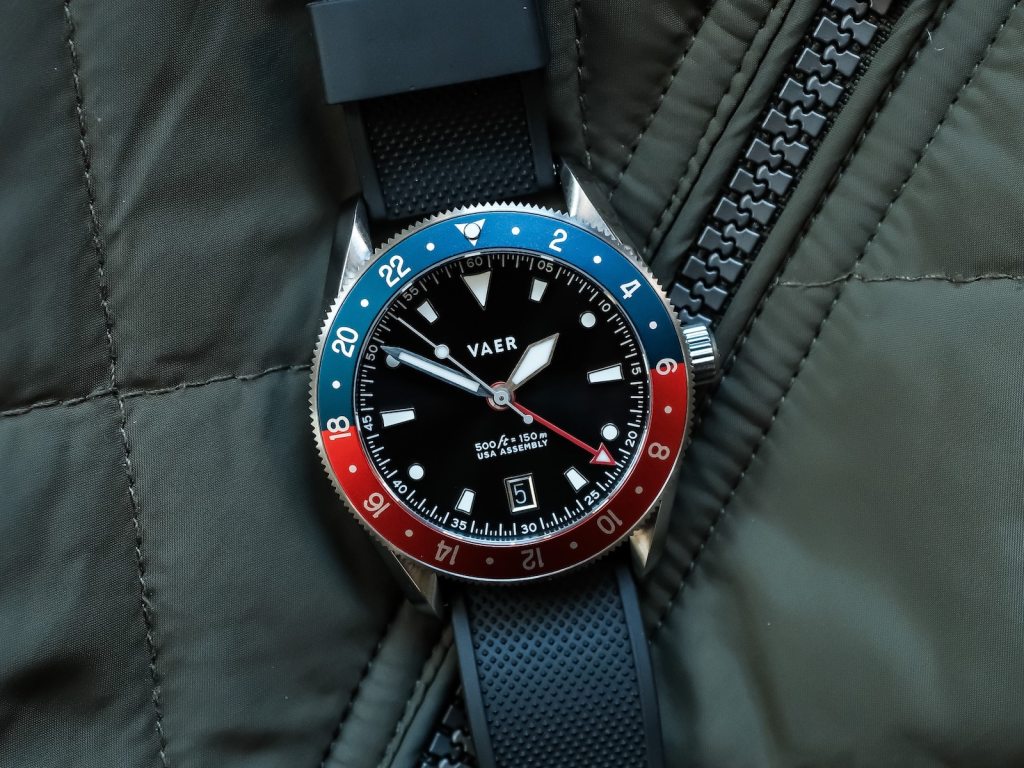
A GMT isn’t essential for every one-watch collection, but for anyone who wants that extra functionality without taking on the maintenance of a mechanical movement, the Vaer G2 Meridian is an appealing alternative. Its biggest strength is how little effort it requires from the owner. The Swiss Ronda 515.24H quartz movement is ready to go whenever you pick up the watch, while the quick-set date makes getting it running again after a period of inactivity especially easy. With a battery designed to last for years, it fits an ownership style where convenience matters more than the ritual of winding and setting a mechanical watch.
The GMT functionality does come with a familiar limitation. This is a caller GMT, so it doesn’t offer the independently adjustable local hour hand that frequent travelers may want. For occasional trips or simply keeping track of another time zone, though, we found that limitation fairly easy to accept. In some ways, the convenience of quartz was more valuable than having a mechanical GMT that needed to be reset every time the watch had spent several days sitting unused.
The compact dimensions reinforce that practical philosophy. Measuring 39 mm in diameter, 46 mm from lug to lug, and just over 10 mm thick, the G2 Meridian has a low-profile presence that quickly becomes easy to forget on the wrist. It doesn’t feel undersized, but it also avoids the bulk that can make some GMT watches uncomfortable for extended periods. The 150-meter water-resistance rating and screw-down crown further encourage the kind of worry-free daily wear this watch is designed for.
Vaer has also managed to give the case enough refinement to work in more formal settings without stripping away its tool-watch character. The combination of brushed and polished surfaces provides some visual interest, while the engraved caseback adds a thoughtful touch. On the dial, applied markers, a centered six-o’clock date window, and a straightforward handset create an uncluttered display that’s easy to read. The lume isn’t exceptional, but it remains effective enough for normal nighttime use.
The bidirectional Pepsi bezel is another practical feature. Its clicks feel firm and reassuring when making adjustments, although there is some noticeable play and the alignment isn’t always perfectly centered. Enthusiasts who obsess over bezel positioning will probably notice it more than casual owners.
Between the two supplied straps, the rubber option is the stronger choice in our experience. It has a more substantial feel than some of Vaer’s earlier straps, tapers naturally, and matches the lightweight case particularly well. The NATO strap, by comparison, feels somewhat stiff and doesn’t integrate with the watch quite as naturally.
Ultimately, the G2 Meridian isn’t trying to win over collectors with mechanical complexity or enthusiast-focused specifications. Its appeal is much simpler: it provides useful GMT functionality, a compact case, solid water resistance, and very little maintenance. If your idea of a one-watch collection involves setting it once and getting on with your day, the G2 Meridian gets that philosophy right.
Pros
- Compact and slim dimensions make it comfortable for extended daily wear.
- Swiss Ronda quartz GMT movement keeps ownership simple and low-maintenance.
- Rubber strap provides a better match for the case than the included NATO.
- 150-meter water resistance and a screw-down crown make it suitable for worry-free everyday use.
Cons
- The Pepsi bezel has some noticeable rotational play.
- Bezel markings can occasionally sit slightly off-center when carefully inspected.
With $1,000 to spend, you actually have more solid options than most people realize, which makes picking just one watch to own trickier than it seems. The best pick isn’t about what impresses people who see your collection—it’s about matching a watch to your actual daily life. So if there’s a watch under $1,000 that’s earned a permanent spot on your wrist for years running, tell us why it’s stuck around. You might just talk us into spending way too much time hunting down our next review unit.

 Wrist Perspective
Leave a comment