Carbon, Racing Heritage and a Modern Edge
Some watches are designed to follow trends. Others are built around a history that gives them an identity of their own. The TAG Heuer Monza belongs firmly in the second category.
Originally introduced in 1976 to celebrate Ferrari’s Formula 1 World Championship victory, the Monza has always occupied a slightly different place within TAG Heuer’s catalogue. While the Carrera and Monaco became the brand’s most recognizable icons, the Monza developed its own distinctive personality—one closely tied to motorsport, speed and bold design.
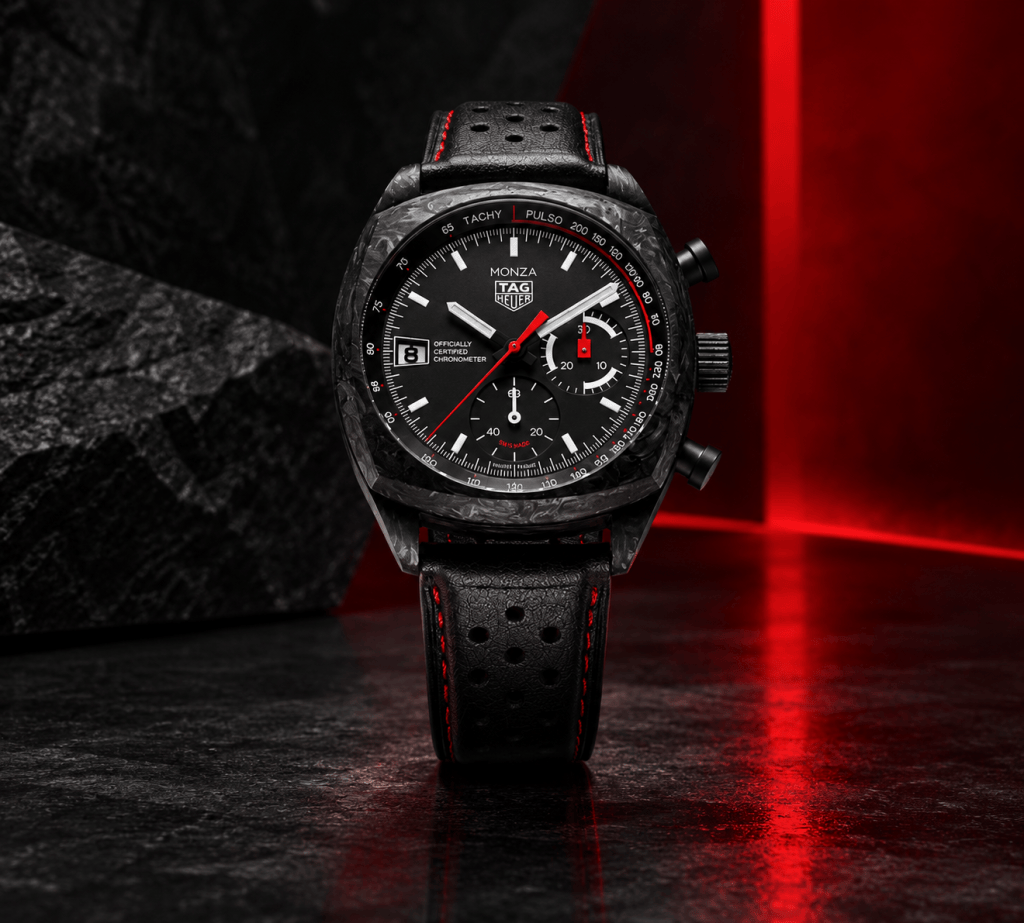
Now, that racing spirit returns in an especially aggressive form with the TAG Heuer Monza Flyback Chronograph, featuring a lightweight carbon case and a distinctly modern interpretation of the original Monza formula.
A design shaped by racing
The Monza’s appearance has changed considerably throughout its history, but one element has remained central to its character: an unmistakable case shape.
Early Monza models from the 1970s were known for their unusual, almost oval or cushion-like cases. TAG Heuer later evolved the design into the more angular, rounded-corner silhouette associated with the modern Monza.
This latest version takes that familiar shape and pushes it toward a much more technical aesthetic.
The 42mm case is constructed from carbon, immediately giving the watch a darker, more contemporary presence while also reinforcing its motorsport character. The case measures 15.22mm thick and is paired with a fixed carbon bezel and a carbon crown featuring TAG Heuer’s shield logo.
Water resistance is rated at 100 metres, making the Monza considerably more practical than its racing-inspired appearance might initially suggest.
Black, red and white
The colour scheme is perhaps the clearest connection between the watch’s modern construction and its racing heritage.
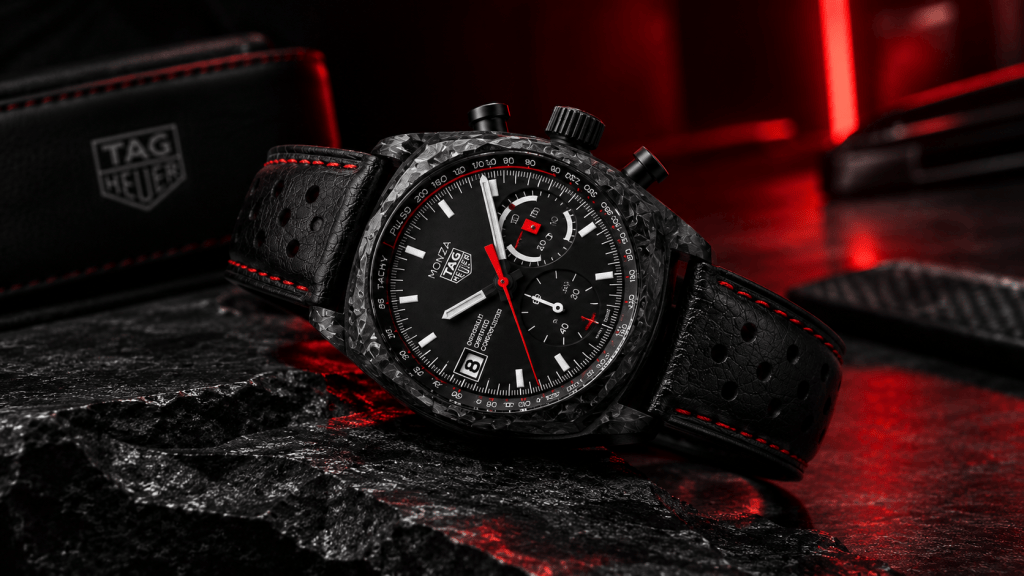
The dial combines black with sharp white and red details, creating a high-contrast layout that feels purposeful rather than decorative. The same colour language continues across the hands, markings and chronograph elements.
The result is a watch that looks fast even when it is sitting still.
The chronograph layout is also slightly different from the original Monza. The 30-minute chronograph counter is positioned at 3 o’clock, while the small seconds occupy the 6 o’clock position and the date display sits at 9 o’clock.
That arrangement gives the dial a distinctly modern character while retaining enough of the original Monza’s visual DNA to make the connection obvious.
A carbon case with titanium underneath
TAG Heuer has taken the lightweight-material theme beyond the main case.
The caseback is made from black titanium, while the chronograph pushers are also constructed from titanium. The combination keeps the visual treatment consistent while giving the watch a technical, contemporary feel.
The pushers control the chronograph functions, including the 30-minute counter, while the overall layout remains easy to read at a glance.
For a watch so closely associated with motorsport, legibility is especially important—and this Monza gets that balance right.
The TH20-12 Flyback movement
Inside the watch is TAG Heuer’s TH20-12 automatic flyback chronograph movement.
Operating at 28,800 vibrations per hour (4 Hz), the movement offers an impressive 80-hour power reserve and contains 33 jewels.
The flyback function is particularly appropriate for a watch with such a strong racing connection. Instead of having to stop, reset and restart the chronograph through separate steps, the flyback mechanism allows the chronograph to be reset and immediately restarted with a single operation.
It is the kind of feature that makes sense both technically and historically on a Monza.
Behind the caseback, the movement continues the black-and-red theme. The skeletonized rotor is finished in black, while the column wheel receives a contrasting red treatment.
The movement is also COSC-certified, adding a significant level of precision to what is already a technically ambitious chronograph.
A strap that completes the package
The watch comes fitted to a black perforated calfskin leather strap.
Red stitching runs along the sides of the strap, echoing the accents on the dial and movement. A black titanium folding clasp with DLC coating completes the setup.
It is a relatively simple combination, but it works particularly well here. A bracelet could have made the watch feel heavier and more conventional, while the perforated leather strap keeps the connection with classic racing watches intact.
Limited to 500 pieces
TAG Heuer is producing the Monza Flyback Chronograph in a limited run of just 500 pieces.
That exclusivity is reflected in the price, with the watch retailing for €13,350.
It is certainly not an inexpensive Monza, but this is also far removed from a simple reissue. Carbon construction, a flyback chronograph, an 80-hour power reserve, COSC certification and the model’s limited production all place it firmly in the high-end segment of TAG Heuer’s collection.
The modern Monza
The new Monza Flyback Chronograph doesn’t try to recreate the 1970s model piece by piece. Instead, TAG Heuer has taken the core ingredients—motorsport, unusual proportions, strong colours and mechanical performance—and rebuilt them using modern materials and contemporary watchmaking.
That is probably the right approach.
The Monza has never been about playing it safe. Its identity has always been a little more unconventional than the Carrera or Monaco, and this carbon Flyback version embraces that difference.
Dark, lightweight and unmistakably sporty, it feels like a Monza designed for the present rather than a watch simply looking back at its past.
And perhaps that is exactly what makes it interesting.

 Wrist Perspective
Leave a comment